The year started with enthusiasm that, with inflation certainly at range levels of between 2-3%, meant that interest rates were likely to move lower this year, allowing January to be a strong month for markets with the view that President Trump would provide a boost for markets with tax cuts and talk about tariffs but not follow up with any strong action.
Markets, therefore, were risk-on even the arrival of a Chinese alternative to AI but at a much lower cost, did much to dampen the enthusiasm and question the spending of the mega-techs on the promise of AI.
Unfortunately, the last two months of the quarter have seen Trump emboldened by the Republican movement behind him in much more aggressive tariff planning mode, resulting in extremely elevated levels of market and political volatility.
This, as you can see below, has affected the US and the technology sector significantly, where the mega-tech stocks were never going to need that much volatility and potential negativity to cause them to retreat and suffer from their highs, none more so than his ally-in-chief, Elon Musk, whose company Tesla has seen its share price hit significantly in the year so far.
But it has also resulted in the wider S&P 500, which is in correction territory, as the rhetoric has increased concern that any potential deep tariffs will invite retaliatory action and even veer the US economy to a recession later in the year, which in January was certainly not the consensus view.
Not surprisingly, the US and tech sector are at the bottom of the equity charts for Q1. The Fed, who the market expected to cut interest rates by up to 0.5% this year, will now be concerned that inflation could be on this rise due to tariffs, and rather than cutting, they may have to consider pausing for longer or even raising rates.
The Years winner’s so far have been Europe and China, who perhaps due to their low historical share price after a tough few years, have attracted some forced sellers from the US and, in Europe’s case, the view that more fiscal measures will be needed as the Trump Administration makes it clear in a very unambiguous way that Europe will need to look after itself and the US, at least for the next four years, will not fund the Ukrainian war effort much longer.
This threat has made Europe work closer than ever, as the threat posed is very real.
So, Europe, without a strong partner, has realised that their fate lies in their own hands, and sectors such as Defence have been beneficiaries.
UK Equities has headed a reasonable quarter as the Government still looks to find that positive momentum going forward.
India, after a strong couple of years, gives back some of its gains this year but remains a compelling long-term story.
China, if it is to follow up with further positive market movement, will need to stimulate further.

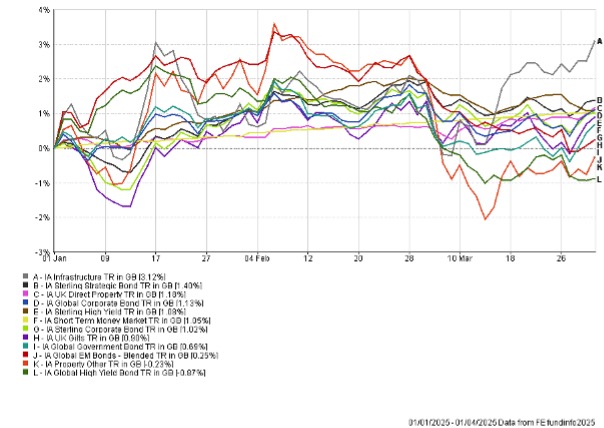
Non-equity sectors have performed well with bonds and cash, some much-needed safety and diversification for portfolios, as in normal economic theory, this is how assets are supposed to work.
The path of interest rates in the US certainly is debatable, although it may still be lower, brought on by an unexpected recession rather than the Fed feeling inflation is tamed. They will, during the year, need to decide whether higher-than-expected inflation due to tariffs is acceptable, rather than a recession, and therefore monetary easing may be necessary against their desire to cut inflation only really on a consistent level of 2%.
The Bank of England will have a similar dilemma, and the ECB, which has been the most aggressive already this year in terms of cuts, may take a breather and digest the direction of economic travel.
Either way, it makes sense to play the bond market by keeping the duration of your bonds well diversified.
Outlook for Q2
As of writing, we are getting the full effect of Trump’s tariff plans, and the effect at the moment is negative for equity markets globally, and this will likely continue until the markets can see what the retaliatory actions will be, but the overall concern is that higher inflation and lower growth globally will be the result, at least in the short term.
During this period, diversification and not making knee-jerk reactions are vitally important. After a positive 15 months or so in terms of equity market performance, we are once again seeing very elevated levels of volatility, and markets, as we know, do not like uncertainty.